Showing posts with label Year C Readings. Show all posts

Thursday, April 14, 2016

They were once like us.

Easter 4

Year C
Revelation 7:9-17


The folks at home eating Chinese take-out on folding TV tables scan the celebrities who come into view as a camera pans the crowd at a royal wedding or some other great national event.

“There's Elton John” 
says mum.
“Who's Elton John?” her granddaughter asks her.
“There's the former Chancellor of the Exchequer and, oh yes, that other fellow who was always on the news during the Falklands war – what's his name?'

If mum would ever just “stifle” and stop talking over the television she would be told who's who in due course. Nicholas Witchell, the BBC's royal correspondent does yeoman service filling in the blanks for those of us who need our memories jogged at great events. That's his job, after all. He knows. In the vision of John of Patmos (which we know in English as the Book of Revelation and which the rest of the world calls the Apocalypse), a heavenly elder turns to John the viewer and asks:

“Who are these, robed in white, and where have they come from?”
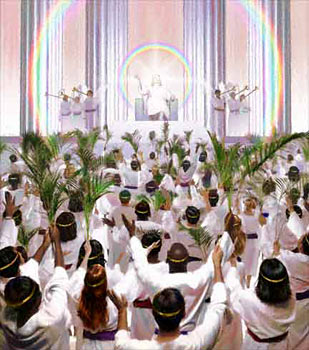
At first glance these figures dressed in white with their palm branches in hand who have gathered around the throne of God and the Lamb are angels or some other heavenly beings. In which case, they differ from me in their very nature. That they can show up at the west door with invitations to the heavenly event is no surprise, being born to it and all.

“John the Revelator” was possibly a prisoner in the island's salt mines when he had his vision. He writes like a Hebrew or Aramaic speaker who's learned a bit of journeyman's Greek along the way. He's nothing special.  So why does the heavenly elder ask him about the identity of the crowd? John appears put-out at this reversal of roles: “Sir, you are the one that knows.” he says.

Why ask the question? Might it be that not knowing at the outset is a part of the process and that a question nails that insecurity better? The first part of the elder's question provokes an immediate response: No, I am not one of those saints. The Revelator must feel the rawness of his own life first - the rags which barely cover his nakedness, the banishment and hard labour on the Island of Patmos. 

Try to remember that the emphasis in the elder's question is on the second part:  “...where have they come from?”  The “clearly not me” surrenders a little bit in the elder's explanation that these are ordinary humans who have 

"...come out of the great ordeal; they have washed their robes and 
made them white in the blood of the Lamb." 

My life in the salt mine as an exile for Christ performs some change in my nature. The pain of faithful life is not wasted. I am a prisoner. I am a member of a persecuted religious minority in a Roman outpost. I write in a language in which I have no ease because I am impelled to testify to the victory of God in the presence of my brothers and sisters. I am a member of a tiny church with a difficult demographic and an uncertain future. My faith is pretty well all that I have. I struggle to profess that faith in the midst of colleagues, parents or children who share little of it. 

I now know the answer to both sides of the elder's question:

I am not there right now.
But those who are 
or will be there
were once where I am now.


Friday, April 08, 2016

Simon Peter in the school of love.

Easter 3
Year C                                          
 John 21:1-19

Jesus asks Peter – Simon, son of John, do you love me more than these?

These ‘what’ exactly? More than ‘this’ life, represented by the items of a fisherman’s trade scattered around on the beach – these nets, these spools of braided line, these floats?


Or – do you love me more than these other disciples love me?
You, Peter, pre-eminent among my followers:
                      Do you love me more than these others do?

The question arising between a man and a woman or a parent and a child - 'Do you love me?' - might be playful or perhaps it probes at some perceived weakness.

Do you love me? (of course you do)
Do you love me? (I want to hear you say it)
Do you love me? (I suspect that you do not)
Do you love me? (I wonder if you know what that means)

I’ll roll the dice and will hold that:

1. When Jesus asked Peter if he loved him more than these that he was referring to the other disciples gathered with them on the beach.

2. He asks the question three times because Peter has denied him three times and;

3. That when he asked Peter whether or not he loved him he was wondering if Peter knew what that meant.

Because it is not clear that we always know what love means.

You'll have heard of the well-known “tussle” here in the conversation between Jesus and Peter:

Three times Jesus asks Peter whether he loves him and twice he uses the Greek word (agapao) which refers to the type of love which gives and sacrifices, a love which lifts up the beloved.  Peter keeps replying “Yes, Lord I love you” and uses the word (phileo) which is a more ordinary emotional attachment or affection.

You would expect that with the the second  time of asking Peter would have twigged that the repeated question with a particular word was meant to hammer him into shape but, in fact, it is Jesus who draws near to Peter and uses Peter’s inadequate word for love in his final question:  "Peter, do you love me?"

Peter has not yet fathomed the love that Jesus asks about.  Jesus, though, will begin in the place where his disciple stands and use the words that Peter can speak and know here in this School of Love which convenes on a Galilean beach.   It was the same way he encountered Thomas in the School of Faith which met behind locked doors in Jerusalem in last week’s Gospel reading.

Jesus starts where these disciples are but the lesson does not finish there..   The School of Love will carry on.  Peter will come to learn love’s meaning.  Jesus finishes with the words:   “Follow me”.


Thursday, March 31, 2016

The 2nd Sunday of Easter

Year C
John 20:19-31

Thomas doesn't have much of a speaking part in the Gospel of John.

Thomas appears to decline each time he opens his mouth. His first words (John 11:16) were a pep-talk he gave to the other disciples when Jesus suggested a return to Judea where he and his disciples had already been threatened with mob violence. Thomas suggested that they should together go and die with him.  All very noble, this, and the very thing you'd expect an apostle to say.  But something happened to Thomas along the way.  A few chapters later Jesus told his disciples that he was going to prepare a place for them - a home in the heavenly places.  Thomas' response (John 14:5) shows not only that he seems a bit thick and has misunderstood the big picture of what Jesus is saying.  It reveals a deep dis-ease and uncertainty at the centre of his soul

Lord we don’t know where you are 
going, so how can we know the way?

Show me a map.  Explain how it will be.  Tell me where to put my feet.  Which is more or less how Thomas will later challenge the other disciples (John 20:24-29) when he finds himself among people who have witnessed the risen Christ where he himself has not and is asked to share their joy which he believes he cannot.  Show me the map, he says again.  Show me the prints of the nails.  Show me the wounds in the side. 

I will not believe unless…..

This is not a story where the Church mocks Thomas.  Rarely does the question boil down to a  binary issue of whether we have faith or whether we don't as if there were a lottery going on and the lucky among us scratch the little box that reveals with an exclamation mark that “Congratulations you have faith!” and others merely uncover the words “Better luck next time!”  Our Gospel reading this Sunday is a story about God’s active and continuing interest in bringing faith to the surface and nurturing it into visible reality – exactly as Jesus does for Thomas in the story. Faith is discovered by needing and using it and by finding that God indeed makes it possible.   

I've been at this for well over thirty years now and have sat next to all sorts of people facing things which led them to wonder if they had the faith necessary to get through the next month or even the next six hours.  Most of them proved themselves pillars.  Most of them would testify to the active support of something beyond themselves as and while they forged forward with a degree of faith they were not sure they had.

Later stories about Thomas, while in no way certain, are reasonably well-founded.  From his base in Edessa in western Turkey he is said to have then traveled to India.  We may reasonably assume he did so without a map.  He had been schooled in faith at an uncertain time at the wounded hands of Jesus.   You may have been so schooled yourselves.  You may yet be.   You should pray to be.


Sunday, March 27, 2016

Seek, find and be amazed!

Easter Sunday - Year C
Luke 24:1-12


…these words seemed to them an idle tale, and they did
not believe them.  But Peter got up and ran to the tomb;
stooping and looking in, he saw the linen cloths by themselves;
then he went home, amazed at what had happened.

The ancient rubbish tip outside the ancient Egyptian town of Oxyrhynchus yielded a Greek fragment of the curious text of the Gospel of Thomas - an enigmatic book which contains morsels of Jesus material at least as old as our first three Gospels mixed in with odd philosophical and even heretical musings from the third century.  It’s not been included amongst our canonical Gospels for some quite good reasons.  Nonetheless it does yield the odd gem:

(2) [Jesus said], "Let him who seeks continue [seeking until] he finds.
When he finds, [he will be amazed. And] when he becomes [amazed],
he will rule. And [once he has ruled], he will [attain rest]."

There is no question that the disciples and other early witnesses to the resurrection were perplexed, thunderstruck, disturbed and, in the case above, “amazed” by the events of Easter Sunday morning.  That they did not understand immediately doesn’t seem to matter because our Evangelists are telling two parallel stories about the Easter morning events and the appearances of the risen Christ in the days which followed:  What did God do?  And (because the Gospels are designed to be read by men and women of faith and to help refine and underpin that faith with the historical record) How did men and women react to the Resurrection? 

The resurrection of Jesus is not an incomprehensible loud noise which deafens the attending disciples. Their perplexity is temporary.  It will be nurtured into faith through their fellowship with the risen Christ, through his words in the following forty days and through the future confirmation of the Holy Spirit.  This is the remaking of a fallen creation.   God’s pledge is to make that creation new again.  The risen Christ will be not only observed but in fact witnessed (there’s a difference!) and then proclaimed and for that to happen the Resurrection will come to be understood. 

I want to point to one very early response, on Peter’s part, which even preceded his sprint to the empty tomb much less any coherent understanding.  The women had returned with a story which seemed, to the gathered and grieving disciples, a vain and empty tale.  Without any particular textual justification, I can imagine Peter in another room hearing every second word shouted out by grieving and perhaps even angry disciples as they argue with the women.  The words beyond the wall sink in – idle – tale - master – gone – tomb – empty.   The merest shred of possibility presents itself that all is not in fact ended.  Like a dull ember buried deep in the ashes, hope finds a little tinder in Peter’s soul and catches light.   He’s off like a shot.  Prior to faith in full flower there can be both will and openness.  

Keep your ears open.  
Honour the hunger within you.  
Seek until you find.   
Be amazed!


Thursday, March 17, 2016

Palm Sunday 
Passion Sunday
Year C 
Luke 22:14-23:56                                                                                                                   

Do you hear the people sing?

The most recognisable song from “Les Misérables” is set amidst the decay and turmoil of Paris in the 1830’s.   The song is defiant and hopeful.  It is a young person’s song.  The voice of the people will lead the way.  They can be trusted to do the right thing.  Well that’s the theory anyway.  

A number of you this Sunday will note how the long Passion Gospel from Luke is divided up amongst the several voices expressed in the story.   We all have our parts to play.  It’s fitting that ordinary human voices should be heard. 

Jesus has a voice in this long reading. 
Pontius Pilate and the religious authorities in Jerusalem have their voice as well -
and of course there’s that voice of the crowd or the assembly calling out in unison: Crucify him!

What is a crowd, anyway?  Like the man said in the fine print:  Your experience may vary.  

If you’re a policeman a crowd is something to be controlled.  If you’re an entertainer, you might look at the crowd in front of you as something you need to whip up or encourage to sing along with you or to laugh at your jokes.  Those of us who live in democratic societies look to crowds to cast a vote in general elections and referendums.   We delegate, to their hands, the destiny of our nations.

For most of us Passion Sunday is also Palm Sunday.  At the beginning of our service we heard the voice of Jesus’ followers crying out during the Triumphal Entry into Jerusalem that Jesus is blessed and that he is the coming Messiah.  And so we cannot avoid being smacked in the face by the change in the crowd’s tone between one Gospel and the next.  Let’s not try to score any easy points.  This is not a jab at the madness of that particular historic crowd in Jerusalem nor does the Gospel reading join us in in our disdain for a crude contemporary public whose taste in music, religion or politics we might despise.    To avoid ever accusing somebody else we are therefore asked to take our part in the readings this Sunday. 

We are the judged and not the judges. 

Salvation is the gift accomplished by Christ for us and freely given to us.  That’s what the Gospel accounts are at pains to show us in the layered drama of the Passion accounts.   Any potential partners in salvation are peeled away from the story.  Pilate (and with him the greatest administrative state the world had ever known) is out for the count.  The priests and the scribes are out as well (and with them the historic religion that presumed to know God best).  The disciples, Judas - even Peter - either betray or deny Jesus.  God shoulders the burden of the cross himself.    And as for the voice of the people?  

 The crowd, it would appear, is just another failed actor.  


Thursday, March 10, 2016

Lent 5 - Year C
John 12:1-8


“The house was filled with the fragrance of the perfume”

How bright is the lamp? 
How powerful is your space heater? 
How potent is the perfume? 

How able are any of these to fill a room with light or heat or fragrance?  Somebody out there knows the maths and can hold forth on Lumens or British Thermal Units to explain it.  I certainly can’t.

How much is too much?  Rooms can be overheated.  Lights can be too bright.  If you’ve ever sat in a movie theatre, with a group of ladies of a certain generation on their night out together behind you, you know that perfume can be too strong.

Is this what Judas is griping about - that Mary has cracked open a one-pint alabaster jar of expensive imported perfume?  It’s too much, he says, not only wrong but unnecessary!  We might have spent money differently and in a less extravagant fashion.  This comment earns Judas a direct rebuke from Jesus in the story and a critical side note from John the Evangelist which rubbishes his character and his motives.  What John knows (and what you know) is what Jesus reveals just prior to the last supper:  Judas is on the wrong side of the fence – as critics sometimes are.  He feigns an attitude of care but fears the loss of his control.

Who is in control?  These are little people, remember.  They are not the big beasts of their generation.  Moreover, they stand at the beginning of a chapter in Jesus’ earthly life where nobody but God is in control.  The anointing at Bethany is the overture to the Passion Narrative in John’s Gospel as well as Mark’s and Matthew's Gospels.  It is the starting gun.  From this point on, everybody from Judas to Peter, to Pontius Pilate and the High Priest plays the role that has been chosen for him and the son of God goes to the cross as it has been written. 

She’s done it before - Mary of Bethany.  She correctly discerns what the right attitude in such circumstances might be – the “one thing [which] is needful” in this prelude to Christ’s Passion.   It alone makes sense at the beginning of a week which will see their world turned upside down.   It takes the form of an extravagant and overt act of adoration, of love and of worship. Wordlessly she draws attention to the One in their midst who is giving himself for the life of the world

It is a gift beyond argument, dispute and objection. 
It is the small planet settling into orbit around the grander sphere.
It is the servant bringing the fruits of the harvest to the master. 

She has understood. 
And have you? 

Worship is not a periodic obligation, sparing and conservative (perhaps even self-serving) like one of Judas' disbursements.   It is the pouring out of our substance at Jesus’ feet as a response to what he has accomplished for us.  Even the worship of little people like ourselves has its own power over powerlessness.  It fills the room.


Thursday, March 03, 2016

Lent 4 - Year C                                                                       
Luke 15:1-3. 11b-32                          


Put yourselves in the shoes of one of the characters in this Sunday's parable of the Lost Son:  Which boy are you, then?  You might identify more with the father  – your choice could well reflect the things which have happened to you in the course of your life.  When the Pharisees gathered at the margins of the crowd listening to Jesus speak they noted with dismay how many outcasts and misfits had gathered to listen.  Jesus set the Pharisees more or less this very task:  Who are you in this story?

One of the two boys went off the rails, taking a piece of the family fortune with him.  He came back recently with his hat in his hand after months of indignity, pain and deprivation.  Life “off the rails” proved a dreadful combination of place and circumstance which the boy still cannot describe without tears.  

The father welcomed the lost younger son.  This he did joyfully, extravagantly and with generosity.  He didn't spare his own dignity and even endured being cast as an old fool for the way he ran out on bandy legs to meet the boy when he was still a fair way down the road.  Ridiculous?   Old and foolish?  The only feeling he can remember was the palpable joy and anticipation at having the boy whom he loved and thought he’d lost back at the family table.  That was feeling enough for one day.

The old man now reasons gently with his older son who is mightily put out by his father’s public welcome of the prodigal and is boycotting the homecoming party.  His father was forced to get up and leave the festive table to go outside where his son was lingering under a tree, livid with rage and humiliation.  He speaks slowly to him.  It’s not that the older boy is stupid, mind.   There is, nonetheless, something quite basic that he has not understood. 

What should a father share with a son ?  What does a son inherit?  Is it an inventory of barns, grazing lands, outbuildings, servants and equipment?  When we are strong and in control we might concentrate the goods of the father in our own possession without sharing much of his character. What sort of inheritance is that?  The estate is ours by right.  A jury of our peers would agree.  So what?  If the point of our belonging is that somebody else does not belong, then what does that say about us?  Cold calculations always cast the realm of feelings to one side but this story cannot be divorced from the father’s feelings for the one who is lost - it is the heart and engine of this parable.  It is love and not right which makes the world go round.  

Children are a perpetual worry.  The day of great risk for the prodigal is over.  As we speak now he is in the house wiping a bit of grease from his chin and raising a cup to his lips.  He has been restored to the table.  It is love and concern for the older brother which motivates the father's second trip of the day and all his hushed remonstrations in the garden with a son who, curiously, has everything and nothing at the same time.    

The day of risk for that boy has just begun.  


Wednesday, February 24, 2016

Lent 3 - Year C                                                                                                               
Exodus 3:1-15


Moses had landed on his feet.  He'd escaped a murder charge in Egypt and was now in the process of working on his pension.  He'd met a young woman in the neighbouring land of Midian, married her and had gone to work for her dad Jethro as a shepherd.   On the day in question he was following the sheep along a straight desert track toward better grazing land further up.  Jethro’s sheep would one day be his sheep.   These flocks, this country and this life would be his flocks, his country and his life.  Egypt was all behind him and even more remote was the intrigue of having been a Hebrew hidden like a guilty secret within the household of Pharaoh.  It was a complicated life this Moses had led and one filled with risks since his childhood.

In Midian, though, everything had "come up roses".

Brick fits onto brick.  That’s how the wall gets built.  Chapter is added to chapter until the apogee is reached and the story then can coast to a respectable end.  Moses needed only to keep his eye on the ball.  It was not complicated.  One foot needed to go in front of another.   Those fat sheep must be directed down the straight path. That’s all.  Nothing else.

This would be a good place as any for you to insert your *sigh*.   Do it here.  For at this moment something twinkled on the horizon as a bush spontaneously ignited into flame.   The story of Moses’ commissioning by God and the whole story of the Exodus - the pivotal chapter in Israel’s history – did not debut with God commanding Moses to take off his shoes in front of the burning bush or explaining to him how he would be sent back to Egypt to rescue his people.   It actually began a few lines earlier with Moses’ own fateful words to himself:

"I must turn aside and look at this great sight, and see why the bush is not burned up."

Curiosity kills the cat but it also ushers in new epochs in history.   It changes the fortunes of those who allow themselves the luxury or the lunacy of not looking straight ahead.  Were you chided by teachers, coaches and well-meaning uncles about not following the straight line?  Would you not have been further ahead if you'd refined your resources, purified and concentrated your materials?  "Straighten the lines of your progress..  Above all, don’t get distracted"!  

God constantly stands in the midst of the settled paths of prophets, patriarchs and initiates to the Communion of Saints.  Our iconography has a tendency to depict our heroes with resolute and slightly elevated gazes as they stare intently at their goals.   But - before they were ever useful to God by being resolute and unshakable they were useful to him because they could be distracted - distracted from their day jobs and unstuck from all their several necessary trajectories.   God could depend on them to shift their gaze from their desks and direct it out the window. 


Wednesday, February 17, 2016

Lent 2 - Year C
Luke 13:31-35                                                                                     


The verb – thelo (to wish, want or desire) appears three times – twice positively and once negatively - in our short Gospel reading from Luke this Sunday.  Herod desires to kill Jesus.  Jesus desires to gather God’s people in Jerusalem under his wings like a mother hen.  The residents of Jerusalem, however, have no desire to be so gathered.  It’s a bit like watching from a hillside as two cars speed towards each other along perpendicular routes.   “Stop”, you cry, “or something terrible will happen”.  There are shades of Italian opera here – Giacomo desires Lucinda, Lucinda desires Paulo and Paulo is completely uninterested or is distracted or is a fool or is simply not the marrying type.  If your high-school-aged child related a similarly connected string of unrequited love amongst her pals in class you might say to yourself:  My word, this will all end in tears.

The question of the Gospels is this:  How will God win for himself a family in the ministry of Jesus his son?  
·         The stakes, you see, are so high, 
·         the power of Jesus’ enemies is so strong 
·         and the hearts of the people are so cold and resistant.  

And now Jesus proposes to leave the Galilee and proceed forthwith to the city so long a source of death to prophets.  That impact at the crossroads is certain.  The result of this impossible equation of love will indeed, either by accident or design, be tears.

Have your ears have been open for the last few weeks?  We are full-steam-ahead towards the tears of Holy Week and Good Friday.  In the story of the Transfiguration, which we read together on the last Sunday of Epiphany (Luke 9:28-36), Moses and Elijah were perceived, at either side of Jesus, by the sleepy disciples.  What they discussed was specifically what Jesus would accomplish in Jerusalem which was ‘his departure’.  On the first Sunday of Lent readers were sent back to an early moment in the Gospel account (Luke 4:1-13) where Jesus deliberately set aside and rejected the very tools – safety, strength, the gift of kingdoms and acclaim – which would have prevented those tears and guaranteed his domination of the crowds and his welcome by the several hierarchies of his day.  Jesus forswore these means – one after another.  They were not his Father’s gifts.

What we must piece together from the narratives and sayings of the first three Gospels is clearly stated in the Prologue in John at the very outset:  Light [had] come into the world, and men loved darkness rather than light.  The remedy from the beginning will be Jesus’ self-giving unto death.  He knows himself to be part of a big story and Herod can therefore have no part in it.  Herod's ghastly desire is an empty threat.  Jesus words to him are rightly a rebuke.  Jesus is aware of the weakness of human beings.  They cannot be led like an army or instructed like a classroom.  His words concerning them are rightly a lament.  They are broken and he must die for them.  He will hold them in his lasting and effective love forever. 


Thursday, February 11, 2016

The First Sunday in Lent
Year C
Luke 4:1-13


Sunday School children will tell you that the answer to any question is always “Jesus”.  The answer to the question “What is the story of the Temptation in the Wilderness about” is no exception.  In other words, it’s not about you.  Luke is not coaching you about chocolate, card games, red wine or exercise.  These may be issues - you’ll simply need to find another text.  In this Sunday’s Gospel reading we are observers of the beginning of Jesus’ ministry following his baptism in the river Jordan and as we go through the opening words of the episodes in Mark’s, Matthew’s and Luke’s version of the story we note a subtle difference in language

Mark:  The Spirit immediately drove him out into the wilderness…
Matthew:  Then Jesus was led up by the spirit into the wilderness…
Luke:  Jesus, full of the Holy Spirit, returned from the Jordan, and was led by the spirit for forty days in the wilderness….

Matthew and Luke are the only two writers who detail the explicit events of Jesus’ sojourn in the wilderness – what he came to define or discover or to show about himself and it is fitting that they express this as being at the leading of God’s Spirit.

Two questions could be asked.  What happens to Jesus in the wilderness? And what will happen in the story as it continues beyond our reading into the first verse of the next part of Luke’s account - 4:14?  Second things first, alors.  Beyond the end of our reading Jesus will emerge into his public ministry in the Galilee still very much in the power of God’s Spirit in his words and acts.  Whatever happened to him in the desert has not compromised him.  It has defined and sharpened his mission.  Back to the first question: So what happened in the wilderness?

In the wilderness Jesus lived with gaps – with things that he did not have.  He had no bread (hunger).  He had no power or public acclaim (solitude).  He had no safety (at the mercy of beasts and thieves).  The devil offered him solutions to these problems which, on one hand, might seem to better equip him for the public ministry that will follow but for which faith in God could never be credited.  Jesus said no.  The power of the Spirit remained with him.

It will take an entire Gospel to explain how God expresses his saving power through this Jesus who refuses a crown and speaks the truth powerfully from a standpoint of weakness and want.  You’d need to add the letters of Saint Paul to find out how a rag tag collection of early Christians will express that same invitation to God’s friendship.  Add to that cloud of witnesses St Francis and St Claire, every missionary to a hostile population, every Christian activist who bore witness to powerful oppressors.  It has ever been so.  


Thursday, January 14, 2016

The Second Sunday after Epiphany
Year C
John 2:1-11                   


Those of you who read up on the Auvergne before moving here will know that this was one of the great wine regions of France before some bright spark had the clever idea of bringing vines over from the New World to plant on French terroirs and took little notice of the tiny aphids (Phylloxera vitifoliae) clinging to both root and branch of the American vines he shipped in on the boat.  The rest is sorry history.  The restoration of the wine industry with new grafted vines came late to our region.  Our local wines are only now beginning to climb back on to the register.  Good wine is produced after decades or centuries of interaction between grape type and soil consistency.  Good wine isn't produced in an instant.  Unless you were a guest at the wedding at Cana, that is....  On that occasion copious amounts of the very best quality wine issued from stone containers which had to that point contained only water.  I remember one of my past parishioners expressing frustration with me that the story required any explanation at all.  Didn't I believe in Jesus?  Don't I believe in miracles? If Jesus is on site, then miracles happen and bad situations are reversed - these thirteen words are all that is required.  Here endeth the sermon.

Calm down dear (I wanted to say but didn't).  John's Gospel puts it like this:

Jesus did this, the first of his signs, in Cana of Galilee, and revealed his glory; and his disciples believed in him.

A sign points beyond itself to something else.  Even if it begins with a particular problem in time and space it then points out of the room and away from the cups on the table and beyond whatever problems the party's hosts may have.  Jesus performs a handful of miracles.  When he does they are never merely miracles.  They teach us something about God - wrapped up, as they are, with the larger story of the restoration of Creation in the story of the Word's "dwelling with us".  The story informs much more than any present crisis which the instantly needful might want to aim Jesus at.  The party will go on - with or without wine on the table.  Jesus promises his disciples no shortcuts.  He often tells them that they will engage painfully with the world around them but that they will be equipped by him, through faith in him – the one who drives the nourishment up the vine and swells the full fruiting berry.  It is all about that ineffable thing which we lift our glass of good wine to - which is life itself – full and rich and interconnected.  You might say that there is no shortcut to quality - to quality life anyway as the sort of good wine which a true connoisseur would describe with all those daft wine metaphors: "apples in the nose” or “notes of saddle leather, jujubes, and turpentine with a hint of combed cotton” meaning that the tastes and smells evoke and connect to other worlds and experiences.  Signs point to something else. Simple truths open many doors.  

It’s not merely red wine on the table.  It’s not just a miracle.  


Friday, December 11, 2015

The Third Sunday of Advent
Year C
Luke 3:7-18

Image result for john the baptist fireThe idea of fire as an agent of cleansing and renewal appears twice in this passage from Luke’s Gospel.  Useless trees, which bear no fruit, are cast into the fire.  The empty hulls of grain – the chaff – is burned at the end of the harvest leaving the good grains to be bagged and taken into the larder.  We are familiar with one term from this passage – The Baptism by Fire – which we have incorporated into ordinary language to describe any event which seems destructive and hostile but which ends up fitting and preparing us through the ordeal it produces.

When you drive through northern British Columbia and the Yukon Territory along the Alaska Highway (which in my day was nearly all gravel for the 920 miles between Dawson Creek and Whitehorse) you pass through areas which have been recently burned over.  The burnt ground is dotted about with blackened stumps.  It speaks of death and destruction.  If you give it some thought, however, you might be struck by how this section of the forest is now a sunny spot for the first time and standing on what was once the forest floor you can now see the sky.  As you drive along for a few miles more you encounter areas which were burned over a year ago.  Fireweed grows in tremendous abundance, filling in the spaces that have been left.  As you drive further you pass areas which were burned over five years ago.  Small poplars are growing, their leaves shimmering like paper coins in the breeze.  Further on the conifers are new and still small in areas which were burned over a decade ago.  Every hillside around you with its bands of old conifers, fireweed, poplars and new conifers and bear witness to the regular and periodic cleansing of the land through fire.

You – the men and women, the boys and girls of Christ Church Clermont-Ferrand – are being invited by God to repent, to return and to be renewed.  The Advent scriptures come with both promises and warnings because the new life cannot simply be added to what we have already acquired and collected around ourselves over the years.  The natural man will suppose that the promises of new life are extra bits – options if you like - that might go nicely with what we already have.   As you approach the river you should expect to hear loudly that this is not so.  The prophets will all tell you that burdens must be dropped to the road side, taken off our shoulders, stripped and even burned away. 

Where most of our baptisms of fire are involuntary misadventures that come our way by chance or ill luck.  They fall on us.  Your invitation here is something of a quite different order:  you are being invited to enter into the Good News quite voluntarily, to undertake the necessary process of leaving behind what has held back the new growth you desire. 

John the Baptist is telling you quite roughly that you need to decide.  If you want to see the sky again you will need to let some  branches be burned away.


Saturday, September 07, 2013

Proper 18 - Year C
Pentecost 16
Luke 14:25-33


The word “decide”, coming to us from Old French and beyond that from Latin, means to cut something (caedare) off (de) - hence, decaedere. It means to fall on one side of an ambiguity by turning away from the other option. There’s that poem by Robert Frost you read in school about the diverging paths in a forest. If you are a truly decisive person, you will have any number of roads behind you which were not taken and travelled.

See original imageIt depends what you want. As a salesman, in this week’s reading from Luke’s Gospel, Jesus seems not to want to make a sale at all costs. He reminds us, his hearers, that we can have what we want. If we want him, however, and to be a member of the Kingdom which he is ushering in, there will be a cost to that decision. Jesus does not cajole them (or us) with false promises. He doesn’t anesthetize them (or us) with respect to the risks and the costs. He wants us to decide.

Some of us spend rather a long time in those woods looking at the two paths and even attempting to place a foot on each without doing ourselves an injury. We will need to say our “yes” and our “no” to something if we ever hope to get anywhere. We need to come to terms with the fact that decisions are costly.

Being husbands and wives, mothers and fathers, members of a local church and members of God’s Kingdom requires of you a positive affirmation of the life that goes along with that. You might have been surprised at what these roles required - but you suspected all along that there would be a cost.

All your pursuits - your jobs, your family roles, your engagement with the world and your fellowship in this parish church - require, as a first step, not an immediate application of work and energy but, rather, the answer to that nagging question about what you want. Disfunctions may stem less from our lack of native ability than they do from a lack of positive desire. Do you want any of these things enough to walk out of the woods and follow the path?

Jesus puts it plainly: It’s up to you. What do you want?


- Posted using BlogPress from my iPad

Thursday, June 13, 2013

Proper 6 - Year C
The Fourth Sunday after Pentecost
Luke 7:36-8:3
(cf. Matt 26:6-13, Mark 14:3-9 and John 12:1-8)


This Sunday's Gospel takes three slightly different forms in Matthew and Mark and Luke and a completely alternate retelling in John's Gospel:

Image result for mary magdalene anointing jesusA woman of ill-repute breaks into a dinner party made up of worthy people. She anoints Jesus with costly and fragrant ointment and weeps. The onlookers are aghast that Jesus should allow someone so sullied to have physical contact with him or (in Mark and Matthew's version) that expensive ointment has been so extravagantly wasted.

Is it only my imagination or do notorious sinners secretly save things up: money in numbered accounts or bodies buried somewhere?  It seems to me that they accumulate people.   They gather confederates to keep their secrets and friendly policemen to turn a blind eye. They keep a pot of expensive perfume at home to make their world smell better. They save up alibis or excuses which they rehearse. They must even convince themselves. They collect a series of routes home which bypass the people who know them and could denounce them. In the long run the lies they tell to hide their misdeeds become complicated and interlocking and hard to maintain.

Even those who may not consider themselves particularly notorious sinners will recognize this accumulated burden which they bear around in secret upon their shoulders. It may all become too much - as it did for this woman who, one day, decides to end the pretense. She hears the buzz in the market that Jesus is in her neighborhood and will be eating with Simon the Pharisee at his house. She knows the place and that Jesus is a perceptive prophet. There she will be known and exposed. She will come clean.

 It will all come pouring out.

When we love, testify or confess we spread our riches about. We empty our account. And rather than leaving us bereft, the perfume fills the room. Until this point the road has always carried us away from community, away from friendship and away from confident commerce with strangers. Jesus’ very presence can coax us from the tree where we've been hiding, up from the beggar’s corner that has been our lot in life - into community, into friendship and into forgiveness.


- Posted using BlogPress from my iPad